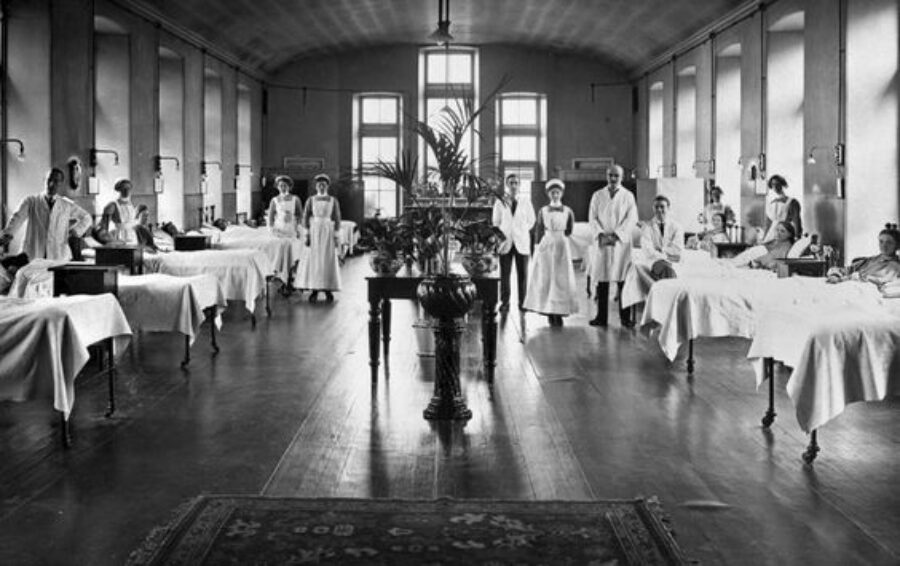
Malcolm's public lecture, at the former Royal Infirmary, now Edinburgh Futures Institute, commemorating the 300th year of the establishment of the English-speaking world's first Medical School.
A Deep History of Health and Healing in Edinburgh
His narrative went back in time, locating the context for care in the town's religious institutions including, first, at the mediaeval House of the Holy Trinity, way up on the bleak moors at Soutra, to the south, where, in Fraser's telling, “a healthy wish for isolation and fresh air was taken to monastic extremes”. And he concluded with a coda wondering why this learning, encapsulated by the axiom that sunshine, fresh air and a view of nature brought with it a substantial and objective improvement in recovery times - of huge financial benefit to the NHS and the economy in general - has been supplanted by a contemporary focus on mechanical ventilation, gizmos and car parks. Malcolm gets to be a historian from 5.30 in, but if you want the coda's polemic, it's at the end, from 49.40, plus his answer to the final question from 58.08.
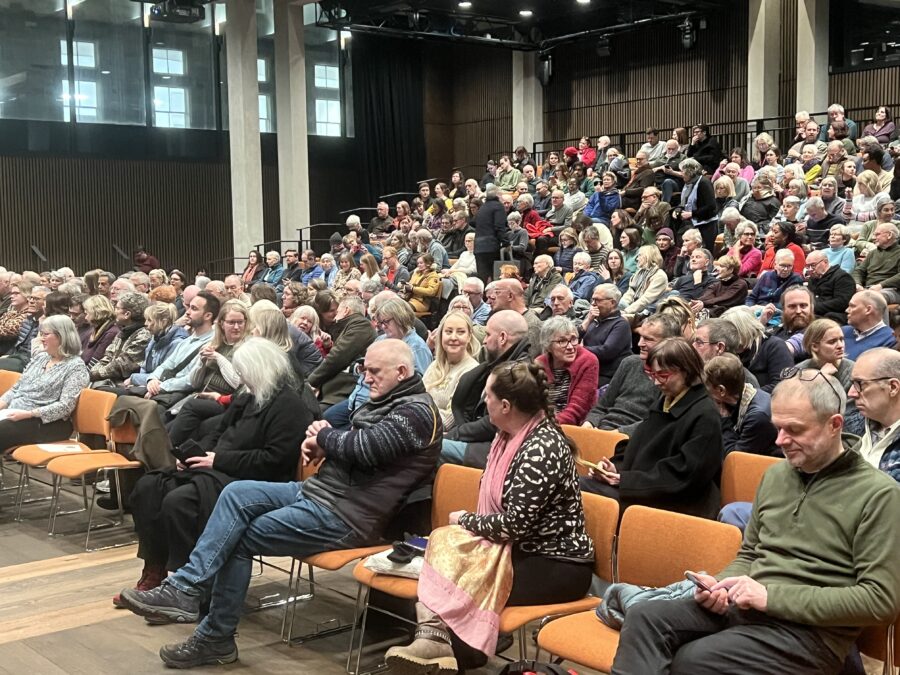
The Lecture was shared with historian Harriet Blakeman and curated by Edinburgh 300 co-lead Gavin Francis, and all three co-authored this accomanying piece in the Scotsman:
Three Hundred Years of Medicine shaped by the city of edinburgh
by Malcolm Fraser, Harriet Blakeman & Gavin Francis
Three hundred years ago this year the faculty of medicine at the University of Edinburgh was formally established, making it the oldest dedicated medical school in the English-speaking world.Three centuries of medical education is worth marking, and a public events programme will unfold throughout the year. There will be community connection projects, a team examining digital frontiers in healthcare, a medical school tartan and a strand examining the global impact of the medical school across its three centuries. This will include a series of public lectures by students and experts, focussed on what we can learn from our history.
The first of these, titled ‘A Deep History of Health & Healing in Edinburgh’, will take place today, Thursday 5th February, led by architect Malcolm Fraser and architectural historian Harriet Blakeman. It will explore the intersection of health with place; with how environmental conditions like fresh air, sunshine and shelter have an influence on recovery. Fraser and Blakeman will explore how these principles have (or haven’t) been expressed in our Edinburgh hospitals across the centuries – even before the establishment of Edinburgh’s Royal Infirmary on Infirmary Street in 1729 (three years after the medical faculty).
The earliest city hospitals were, by custom, religious tradition, and, by necessity, located outside the filth and squalor of the Old Town. The first was in the Blackfriars Friary (the approach to which is still remembered in the naming of Blackfriars Street), whose ministering, Dominican order emphasised a duty of care to the townsfolk. In 1558, with the dissolution of the monasteries, Blackfriars was sacked by the mob. It is no coincidence that the town’s secular High School (on what became High School Yards), and medical institutions like the first infirmary (on what became Infirmary Street), were established there.
There was also the Church of the Holy Trinity, founded by the shores of the Nor Loch. This was the one of several sites occupied by Edinburgh’s Botanical Garden over the centuries; a plaque to commemorate its position stands overlooking Waverley Station’s platform 7. Preceding any of the city’s health education institutions and a full seventeen miles away in the Lammermuir Hills, was the House of the Holy Trinity at Soutra. The reason for its site remains something of a mystery – not only is it a day’s journey on foot from Edinburgh, it's miles from anywhere and was the highest Hospital in Britain, on a road frequently impassable for snow. We might see an argument for the bracing qualities of cold air - but consider that this must have coincided with the ascetic, monkish admiration for austerity, to seek healing in the teeth of the winds.
Both speakers will touch on the many factors that have influenced how and why we have built our hospitals over the centuries – taking in changes in medical innovation, social transformation, and developments in the way that such projects have been financed. Beyond the infirmaries it’ll touch on the 1850s surgical hospital at High School Yards (now Edinburgh University’s department of Geography), as well as the convalescent hospitals of the city, and the Western General Hospital (which grew out of St Cuthbert’s workhouse for the poor).
The siting of Hospitals to aid health by means of sunshine, natural ventilation and a view of nature, found its greatest expression in the 19th century after the Crimean War, including the principles of the (Florence) Nightingale Wards of the Old Royal Infirmary – now Edinburgh’s Futures Institute – which opened in 1879 alongside a purpose-built Medical School at Teviot Place. At the time it was described as ‘probably the best-planned hospital in Britain’. It is remarkable that, in a city sloping north to the Forth, most of its hospitals, including the Royal Infirmary of Edinburgh, the Astley Ainslie, Murrayfield, the Elsie Inglis and the Princess Margaret Rose were all sited on south-facing slopes, with views south to hills, parks and trees. Recent research has confirmed these simple facts: that sunshine, fresh air and a view of nature aids recovery.
The twentieth century saw enormous pressures brought to bear on the Victorian infirmary, to expand but also to change with the times. The introduction of the NHS in 1948 saw a revolution in hospital design, and there was hope that the Infirmary could be rebuilt piece by piece on its existing site. Blakeman will give the broader view of how Edinburgh’s health and healing institutions changed in context with other developments across Scotland, and unpack the reasons for the Infirmary’s move to Little France.
The way that a society chooses to care for its sick and infirm members says something about that society, as does the way that we train our doctors. 2026 is an opportunity to reflect and transform the future vision of Edinburgh Medical School. The events aim to build a sense of belonging with the community, as well as share gratitude – the medical school couldn’t exist without the support of the people of Edinburgh. As the title of the commemorative poetry pamphlet puts it, in the words of one of our student poets Maria-Ariadna Ghiuta: ‘We are just getting started.’